

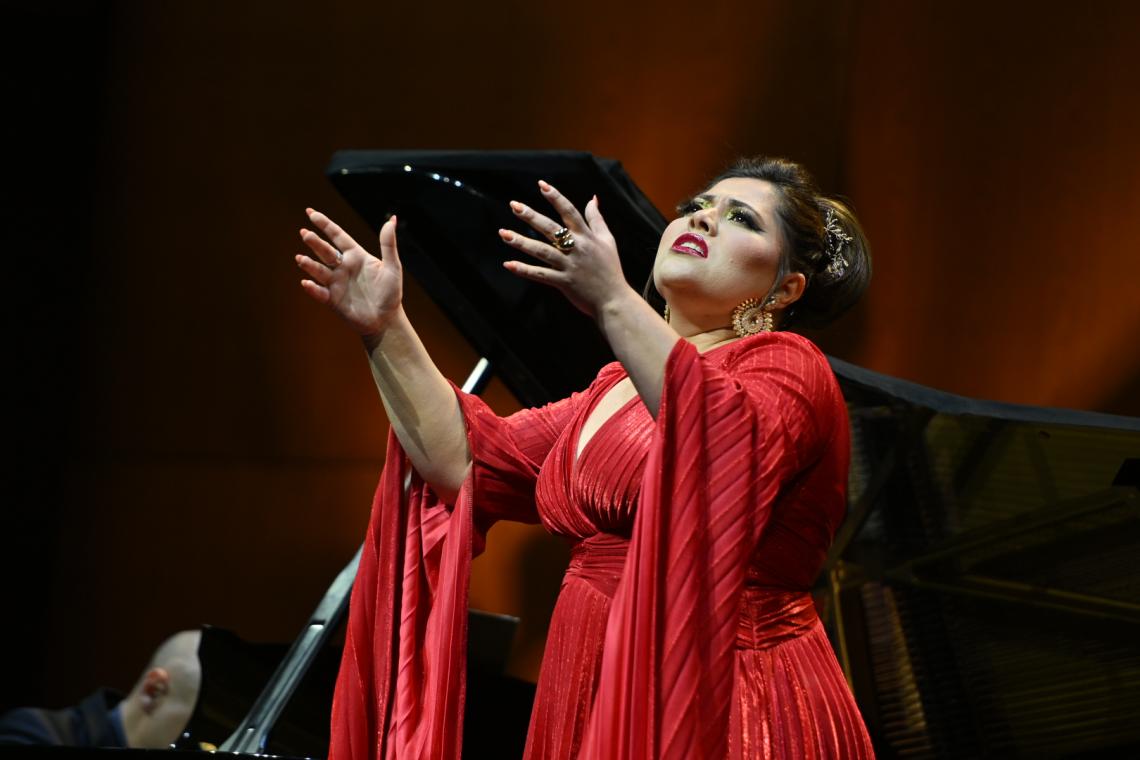
Karla Pineda (1994, Costa Rica) is the winner of the Fifth Prize at the 63rd Tenor Viñas International Singing Competition. The mezzo-soprano also wins the Audience Award for Best Female Voice and two additional special prizes: the Joyce DiDonato Prize, presented by the Houston Grand Opera and sponsored by Carolyn Levy for the most promising young singer of the Competition; and the prize offered by Mrs. Leonor Gago, director of LG Artista Management and Concerlírica Ópera Internacional.
— Once the competition is over, how do you feel?
I am incredibly happy, deeply grateful, and full of energy. Winning a competition like the Tenor Viñas 2026 reaffirms my artistic career and, for me, that fills me with immense pride.
— What led you to the world of opera and classical singing, and when did you decide to pursue it professionally?
My musical training began when I was little with my father. I played several instruments, especially guitar, and also viola. Later, when I entered university to study Music Education, I joined a choir in order to receive a scholarship and be able to study, and that’s where I discovered my voice. I had never sung before; I knew I could stay in tune and I could read music, but I had never actually sung. My choir teachers, and especially a lady named Guadalupe González Creisa, discovered me and kept insisting all the time: “You should study singing.” And I said, “No, I already have my instrument, I play the viola, I want to be an orchestral musician, I’ll continue with my string quartet.” After more insistence, she was the one who pushed me, and I told her I wanted to take singing lessons. I began taking private lessons with her at 21. I started singing ten years ago.
This is my first singing competition here in Europe, and it truly means so much. In fact, several people have been saying, “There’s a contestant from Costa Rica,” and they ask, “Does opera really reach that far?” And I tell them, of course—why not? In fact, according to historical records, the Costa Rican soprano Zamira Barquero won first place in 1980. So for me, it is a source of pride to bring a prize back to my country once again.
— What would you say are your dream roles?
I have several dream roles. I absolutely love and am very eager to sing Santuzza in Cavalleria rusticana. I’m also drawn to strong, empowering female roles with great dramatic weight, such as Amneris, the Principessa de Bouillon, Eboli… The way Verdi elevated women in these major roles. Even Azucena, a character with very interesting and challenging psychological depth, is one of the roles I would love to perform. And as a mezzo, Carmen, of course—I’ve already had the opportunity to sing it, and I feel it’s a role that truly empowers you. I would also love to sing something from the Wagnerian repertoire someday.
— What advice would you give to future contestants?
The advice I would give is that dreams do come true. If you truly have the commitment, the desire, that determination and that hunger—because you must have hunger, that thirst for what you want to achieve—you will make it happen. Dreams really do come true. That’s what I would tell them. Sometimes it’s not only having a beautiful voice that takes you to great places. I believe that in a career as demanding as opera, discipline beats talent. So truly having the commitment and that deep desire to achieve what you want is what I would advise: love it deeply.
— In three words, how would you define the Tenor Viñas Competition?
Challenge, excellence, and beginning—a new beginning.
Costa Rica is a very small country, and it is a great achievement to represent my country. In a way, I also feel that I represent Mexico, since I have been living in Mexico for the past three years. I am part of Ópera Studio Operísima México and Ópera Studio Costa Rica. So this achievement is for Costa Rica, for Mexico, and for all of Latin America, because I was the only contestant from Latin America to reach the final.