

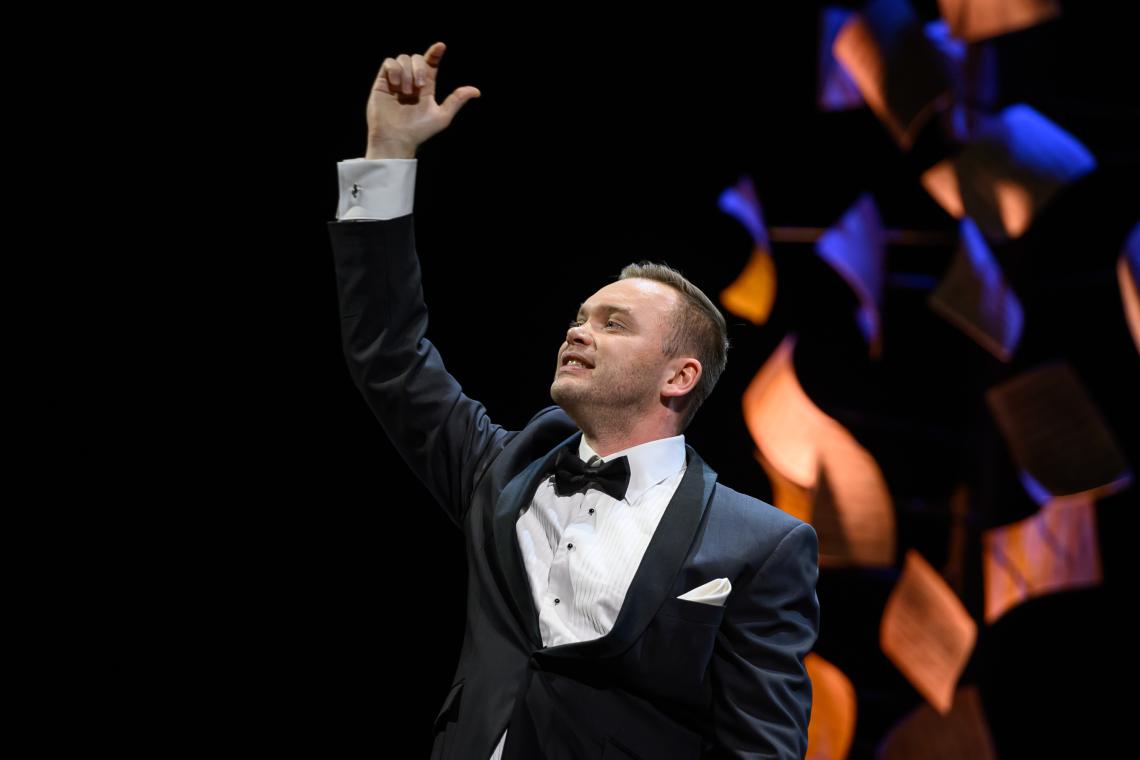
Vlad Tlushch (1992, Ukraine) is the baritone winner of the Third Prize at the 63rd edition of the Tenor Viñas Competition, as well as the Special Prize for Best Zarzuela Performer. After the competition, the team had the opportunity to speak with him to learn more about his journey into the world of opera.
— Once the Contest has concluded, how do you feel?
I’m very happy about everything. I’m still shocked that three Ukrainian singers won first prizes, which is an absolute honor and a big victory for our country during this horrible time, that’s really important for all of us. I don’t mind whether it’s third, second, or fifth place, the important thing is that we are here and we are representing our country.
— What led you to the world of lyric opera, and when did you decide to pursue it professionally?
My whole life I was involved with music and dancing, starting from kindergarten. But then somehow my grandfather, who was an architect, influenced me, and I had two possibilities: to become an architect or to become a musician and singer.
So I first tried architecture, but it didn’t go very well. I can draw a little bit, but I’m not very good at mathematics, which is the most important thing in architecture. Then I decided to try music. I first studied pop music — pop singing — and later I became an opera singer.
Why? That’s a good question. It was just something that was there, and I caught it and decided to try. My first pop music teacher said, “Definitely you can try that. You have a good voice, a big voice — you just need to develop it and work on it.” Then I started college, then conservatory, then opera studio, and somehow I’m here.
— What would you say are your dream roles?
My dream roles, I think in the future — maybe in 10 years — I would love to sing Rigoletto by Verdi, which is my favorite. And now… Il Barbiere di Siviglia, La Bohème (Marcello — I already did it, but I’m still in love with it), Don Giovanni.
Wide repertoire, a good teacher, good preparation, and a clear view of your personality in this business, and the goal — why you are doing this.
— What advice would you give to future contestants?
Right repertoire, a good teacher, good preparation, and a clear view of your personality in this business, and the goal — why you are doing this.
— Què ens pots dir respecte el teu cant de Sarsuela? What can you tell us about your zarzuela singing?
Unfortunately, I can’t speak Spanish, but I have very good teachers: Tanya Lorenzo Castro from Gran Canaria — she is my colleague — and Marcela Rahal, who won first prize two years ago, she’s from Brazil. They both helped me develop my Spanish pronunciation, and I’m very thankful to them.
— What importance do you think competitions like this have for young singers?
It’s fantastic that competitions for young singers are organized; they are very important for our growth. Winning is good — there are prizes, contacts — but what’s most valuable is everything you learn and how much you grow during the preparation.
Supporting these initiatives is essential for culture. In my country, this is not possible right now, and there is a lot of talent that has to go abroad in order to develop. That is why the support of patrons and institutions is crucial: we must invest in preserving traditions such as zarzuela and classical music, and in giving opportunities to young people. We will be the next generation, and we need to continue.
— In three words, how would you define the Tenor Viñas Contest?
Colorful, well-organized, and prestigious.