

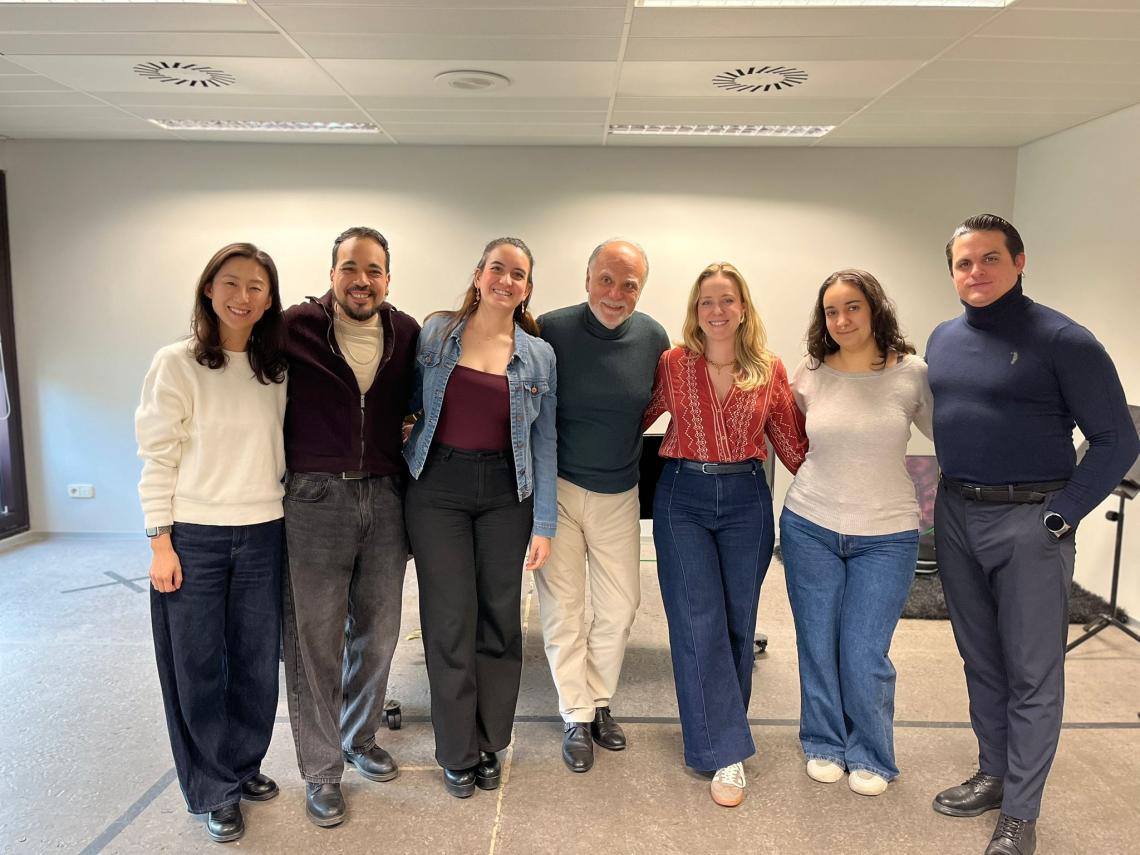
For the past decade, the Tenor Viñas Competition and the Ferrer Music Foundation have joined forces in their commitment to supporting young opera talents. Over these years, this collaboration has become firmly established within both institutions as a leading platform for the training and promotion of new opera voices from the region.
Within the framework of this partnership, the Fundació Ferrer de Música awards the Prize at each edition of the Contest. The prize consists of an intensive two-week programme of vocal masterclasses, divided into two different periods throughout the year. The sessions are led by an opera professional with an established career and internationally recognised prestige, offering the awardees a unique opportunity for artistic and technical development.
In this context, the masterclass programme has featured the participation of the American mezzo-soprano Dolora Zajick, the Italian soprano Mariella Devia, the Romanian soprano Nelly Miricioiu, the Italian mezzo-soprano Sonia Ganassi, the Italian soprano Luciana Serra, the Hungarian soprano Éva Marton and, this year, the Italian baritone Roberto Frontali. Over these ten years of collaboration, more than sixty young singers have received this prize, thus consolidating a network of emerging talents.
Among the beneficiaries are artists who today enjoy recognised prestige and pursue international careers in major European opera houses, such as the soprano Sara Blanc, Carles Pachón and Serena Sáenz.
A week of masterclasses with Roberto Frontali
This edition’s masterclasses took place from 2 to 8 March, an intensive week dedicated to vocal refinement and learning. The participants were Inés Lorans (soprano), Andrés Sánchez-Joglar (tenor), Inés López (mezzo-soprano), Rajiv Cerezo (baritone) and Rosa Maria Abella (soprano).
The masterclasses were structured like this: the singers arrived with their pieces already prepared and performed them for maestro Roberto Frontali, accompanied on the piano in this edition by the pianist Soojeong Joo. After each performance, Frontali offered technical guidance, advice and observations to help them improve various aspects, primarily vocal advice but also interpretative.
At the same time, the sessions became a space for dialogue in which the participants could raise very specific questions to the maestro: how to approach certain passages without reaching the end of an aria tired, how to position the mouth correctly, or how to optimise breathing in order to sustain musical phrases more effectively.
The Contest team was able to speak with the singers to know what they initially expected from this meeting and how they assess the experience once the week of masterclasses had come to an end.
At the beginning of the week, the soprano Rosa Maria Abella explained that she hoped to “learn and refine vocal technique and expressivity, as well as everything that a professional with a career like Roberto Frontali’s can transmit to us.” Once the sessions had concluded, she particularly highlighted the work on the relationship between technique and expressivity: “We worked on how to give the necessary expressivity according to each style, how to bring light and colour to more cheerful arias or those with a brighter tone, and also how to convey expressivity through the very colour of the voice.” She also emphasised the importance of making the body’s support more flexible in order to avoid rigidity and allow the voice to respond with greater freedom.
Tenor Andrés Sánchez-Joglar pointed out that the masterclasses would be very useful for clarifying doubts about lyric singing technique. After the week of work, he particularly emphasised the collective nature of the sessions: sharing questions, observing the work of the other participants and learning through them as well. According to him, this exchange was very enriching and allowed participants to see the evolution of the group from the first sessions to the last. Among the technical aspects addressed, he notes that he was able to resolve issues related to the colour of the sound, especially how to avoid an excessively dark tone and project the voice further forward.
For her part, the mezzo-soprano Inés López commented at the beginning that she would like to work deeper into some technical aspects that posed greater difficulty for her and to work particularly on bel canto repertoire, taking advantage of Frontali’s experience in this style. At the end of the week she confirms that she was able to work more deeply on this repertoire, especially Rossini, although works by other composers were also addressed. “It has been very enriching; we worked a lot on the quality of the sound and, in my case, especially on the placement of the high notes,” she explains.
The soprano Inés Lorans also expressed interest, at the beginning of the sessions, in deepening her work on bel canto repertoire with an Italian maestro such as Roberto Frontali. After the masterclasses concluded, she highlighted that this work allowed her to consolidate and improve her understanding of the style characteristic of this genre.
Finally, the baritone Rajiv Cerezo explained that he hoped Frontali could convey to him the keys to the baritone repertoire, drawing on his own experience as a singer with a long international career. After the week of work, he notes that he was able to better understand which vocal qualities and ways of using the voice allowed the maestro to develop his career, as well as to find tools for tackling this demanding repertoire with greater ease and less vocal fatigue.
With this week of work, the first period of the masterclasses comes to an end. The programme will continue with a second block in July, when the participants will resume their work with the maestro, assess how they have been able to apply and consolidate what they have learned, and continue deepening their vocal development.