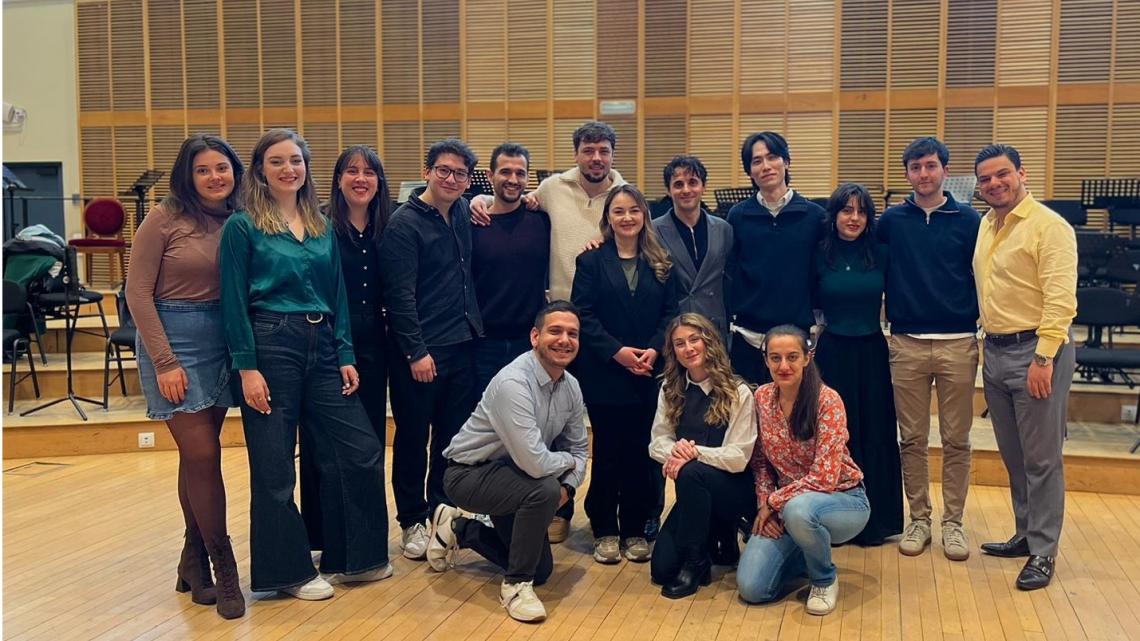
For the second year in a row, Tenor Viñas Contest and Fundación Amigos del Teatro Real have teamed up to support emerging opera talent through Voces en Crecimiento. The event formed part of the 6th edition of Crescendo: Creamos ópera—a programme designed to complement the training of singers, pianists, and assistant stage directors—and coincided with the Winners’ Concert of the 63rd Tenor Viñas Contest at the Teatro Real in Madrid that took place on March.
The aim of the meeting was to create a space for direct dialogue between participants of Crescendo and the winners of the 63rd Tenor Viñas Contest. This year’s edition featured Vladyslav Buialskyi (First Prize), Yuliia Zasimova (Second Prize), and Felix Park (Fourth Prize), along with conductor Julio García Vico. Who led the Orquestra Simfònica del Liceu at the Winners’ Concert of the Contest's 63rd edition, and also conducted the resident orchestra of the Teatro Real for the Tenor Viñas Winners’ Concert held in Madrid.
As institutions committed to supporting the development and visibility of young professionals in the world of opera, it is essential to create opportunities for dialogue and exchange among emerging artists. In this sense, the session became a meeting point where participants shared experiences, concerns, and reflections, bringing together early-career performers with others who are still in training and aspiring to enter the field.
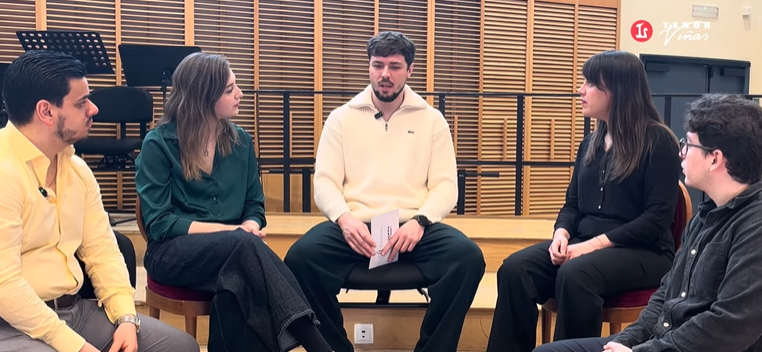
The session was organised into three small groups to encourage active participation and more personal interaction. Each group focused on a specific topic, using a set of guiding questions as a starting point for discussion.
OPERA AND YOUNG PEOPLE: A CONVERSATION WITH VLADYSLAV BUUIALSKY, FIRST PRIZE WINNER OF THE 63RD EDITION
In this group, the discussion centred on the idea that opera may not appeal to young people. However, participants generally agreed that the issue is less about a lack of interest and more about how to reach younger audiences—pointing to challenges of visibility and access rather than disinterest itself. In this sense, they identified lack of familiarity as a key barrier.
At the same time, they noted that many young people perceive opera as something old-fashioned and distant, and as a genre that requires more effort to interpret and fully enjoy than others. Even so, they emphasised that it offers a unique emotional experience, quite distinct from more conventional forms of music. The conversation also explored how to spark interest and bring opera closer to younger audiences, including whether adaptation is necessary. The general view was that it should not be excessively altered, but rather that its intrinsic richness and quality should be highlighted. The key, they suggested, lies in striking a balance between preserving its essence and engaging with contemporary trends. Another important point raised was the need to introduce opera to children and teenagers, who were described as especially receptive and capable of appreciating it.
From a contemporary perspective, also emerged the idea of taking opera beyond its traditional spaces. Initiatives such as concerts in everyday settings—neighbourhoods or other unconventional spaces—can help break down the sense of distance that not only young people but the general public may feel.
Finally, participants highlighted the importance of the visual and theatrical dimension in attracting new audiences. More striking and accessible productions can help create that first connection. Ultimately, the key challenge is to bring live performing arts closer to young people and raise awareness of them, while unlocking their potential without the need for excessive transformation.
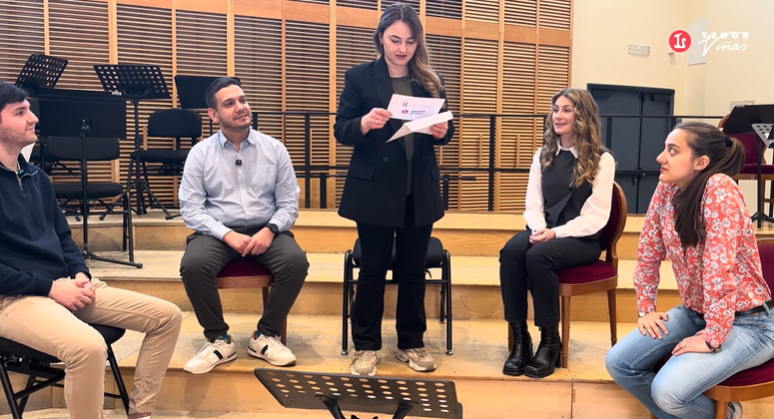
EDUCATION AND PROFESSIONAL DEVELOPMENT WITH YULIIA ZASIMOVA, SECOND PRIZE WINNER OF THE 63RD EDITION
The second group focused on the challenges of building a professional career in the world of opera at a young age. In this context, perseverance emerged as a key factor, rejection is common and must be handled with a clear, objective mindset. They also emphasised the importance of separating artistic criticism from one’s personal identity, as well as maintaining self-confidence. The support of one’s close circle—friends and family—was likewise highlighted as essential for staying emotionally grounded in such a demanding field.
When it comes to opportunities, the group noted that they are increasingly abundant, particularly in Europe, where competitions, young artist programmes, and training initiatives help facilitate the first steps of a professional career. By contrast, in other regions such as Latin America, these opportunities are more limited. One Crescendo participant from Latin America pointed out that he experienced a significant increase in professional opportunities after moving to Europe. In any case, participants manifested the importance of being proactive: seeking out open calls, competitions, and training programmes, as well as building connections within the sector in order to gain visibility.
This group included a pianist and a stage director as Crescendo participants, who offered perspectives that differed from those of the singers. They spoke about having significantly less visibility compared to singers, as well as fewer specialised training opportunities. As a result, they often have to find alternative paths into the profession, relying more on self-directed learning and building professional connections.
As a final point, the prizewinner Yuliia Zasimova emphasised that when it comes to launching a career, the goal is not to compete with others, but to challenge and develop oneself, and to build a one's own artistic identity.
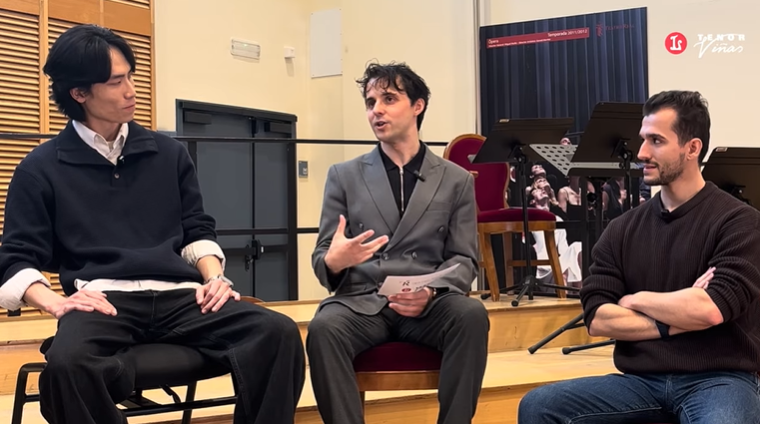
SOCIAL MEDIA, AI AND THE FUTURE OF OPERA WITH FELIX PARK, 4TH PRIZE WINNER OF THE 63RD EDITION AND MAESTRO JULIO GARCÍA VICO
The third group discussed on the role of social media and AI, and their application in the world of opera. When it comes to social media, participants saw it as a key tool for promotion and for shaping an artist’s public profile. They concluded that, unlike in the past—when visibility largely depended on the press and major opera houses—today artists can manage their own image and reach wide audiences directly through social media. This helps democratise access, but it also creates pressure to maintain a constant presence.
They also pointed out that social media makes it easier for artists to connect with one another and helps bring opera closer to new audiences, particularly younger ones. Julio García Vico noted that social platforms place opera singers within the same consumption ecosystem as mainstream music artists: on a single platform, users can instantly access both a pop singer’s video and an opera performer. This coexistence helps break down traditional barriers between opera and its audiences, making it more accessible. Not long ago, opera was largely confined to the live experience in theatres; today, its presence online broadens that reach. As a result, its visibility and relevance in the current cultural landscape are strengthened. Overall, the group concluded that social media is no longer just a useful tool, but an essential element in keeping opera alive and connected to the present.
When it comes to attracting younger generations, participants argued that opera can be appealing precisely because of its authenticity and its unique nature as a live experience, in contrast to everyday digital consumption. In this sense, as Felix Park pointed out, preserving tradition can, somewhat paradoxically, be an effective way of engaging new audiences.
As for artificial intelligence, opinions were more varied, particularly regarding its use in consumption. Some participants use it regularly in their daily lives and as a professional tool—such as Julio García Vico, who applies it in the creation or adaptation of repertoire—while others make less use of it.
Overall, its potential is widely acknowledged, but so too is the risk of losing the more personal and artistic dimension—what makes art human, and especially what defines live performance. In this regard, the group agreed that, for now, the live arts remain irreplaceable, as imperfection, emotion, and human presence are elements that technology cannot replicate.