

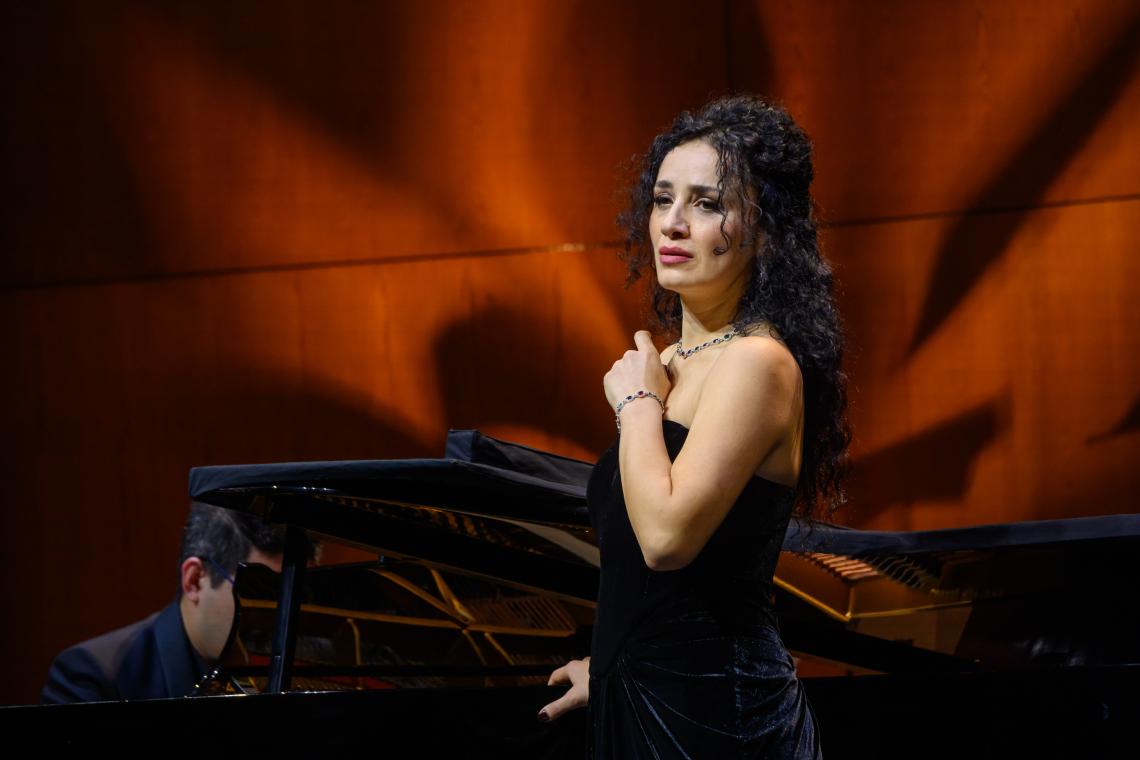
Ketevan Kemoklidze offered the audience at the Final of the 63rd Competition a very special recital. With this appearance, the mezzo-soprano, currently one of the most highly regarded on the international operatic scene, returned to the competition twenty years after taking part as a contestant and being awarded a prize, specifically in 2006 at the 43rd edition of the Competition.
— Twenty years have passed since your participation in the Tenor Viñas Competition. What does it mean to you to be back here today?
Twenty years ago, I was lucky enough to take part in the Tenor Viñas Competition, and I could never have imagined returning to sing here after twenty years. For me, these twenty years mean that my professional career has developed and that I am on the right path, because the years teach you and have allowed me to sing in many places and continue moving forward. So, to mark these twenty years with this competition, after my first appearance here, is very meaningful.
— What do you remember about your experience in the competition? What did it mean to you?
I was rehearsing for the production of Otello at the Liceu while I was taking part in the competition. The Viñas Competition holds great significance for Georgians, because many Georgian singers begin their careers by participating in it. There are many Georgian singers with international careers who started here, in this theatre, with this competition; it was the first time they sang abroad, since for political reasons it was very difficult to leave Georgia. The Viñas Competition gave Georgian singers great opportunities to travel and to be heard.
For me, it was a great opportunity. The competition was very important because, for young artists, it is essential to be heard by many people. Auditioning is important, but having all the theatre directors listen to you in the same place is extremely valuable. For me, it was decisive, because after this competition I received many contracts. I believe competitions play a major role in young artists’ lives, as they open many doors. Especially for me, as I was very young, had just left Georgia, and was still studying at the conservatory. I am very grateful to this competition.
— Where are you in your professional career right now?
I believe singers never stop developing, because continuing to grow is essential in order to be on stage. Even when you have reached a certain level, you must always move forward. I find myself at a very interesting moment in my career. I think the path I have taken and the one ahead of me are both very exciting, because I was fortunate to sing a great deal of Mozart, Rossini, and others, and now my repertoire includes roles such as Eboli, Carmen, or Amneris—larger roles. For young singers, it is very important to carefully follow the development of their voices. Never rush things, always listen to the possibilities and capacities of your body and your voice, and follow your vocal instinct.
— How have you prepared the recital?
The first thing I did was look at the programme I sang twenty years ago. There are some things I could not repeat, but I did sing La favorita by Donizetti, so the first number will be Leonora’s aria. I will sing Carmen, because it would be impossible for me to appear without Carmen. I will also sing a Georgian song for the first time at the Liceu, a zarzuela, the Princess’s aria from Adriana Lecouvreur, and Mompou.
— What is the most important skill a singer must have?
I think there are some essential qualities: the voice, artistic intuition, and talent—not only to sing, but to portray a role convincingly for the audience. Musical education is also very important, because sometimes you have to learn a role in just a few days.
I believe that nowadays singers have more “duties” than before, because they must not only maintain vocal form thanks to a solid technique, but also stay in very good physical shape, as today’s demands are greater. We have many modern productions, and we must meet those demands. Being physically fit is positive both for your health and for singing well.
It is also very important to know how to communicate well, because we communicate with the audience, agents, theatre directors, stage directors, and our colleagues. Human communication is fundamental. And nowadays it is also important to know how to present yourself, because we live in a world of social media and we must show ourselves in an engaging way for audiences and theatres. We may sing well and act well, but ultimately we depend on the audience and on theatres.
That is why young singers must know which side of their personality and artistry to show, so that when someone has to choose, they choose them and not someone else. Singers today must be more complete: sing, act, communicate, present themselves well… many things come into play.
It is also important that nowadays many singers have the support of their families. That is another support network, and I think today’s singers have more support than in the past.
— What advice would you give to future contestants?
Enjoying the moment of singing is the most important thing, because if a singer enjoys their art, they can transmit that to others. Be grateful to be in such a wonderful, magical, and historic place. The Liceu embodies all those wonderful words.
I remember the first time I sang on that stage: I felt deeply grateful, because it was something I had waited for many years. I believe young singers must have that feeling, because it is magical to sing at the Liceu, where all the great singers of the world have performed.
And if the results they hope for do not come, it means nothing. The important thing is to sing well, enjoy the moment, and continue developing, studying, and fighting for your dreams. I am sure dreams do come true; there is always a moment when they do.
It is wonderful for young singers to win competitions and prizes, but if it does not happen now, it does not mean it will not happen later, elsewhere, or that they will not sing on great stages. The most important thing is never to lose hope and to remain determined to pursue your dreams.