

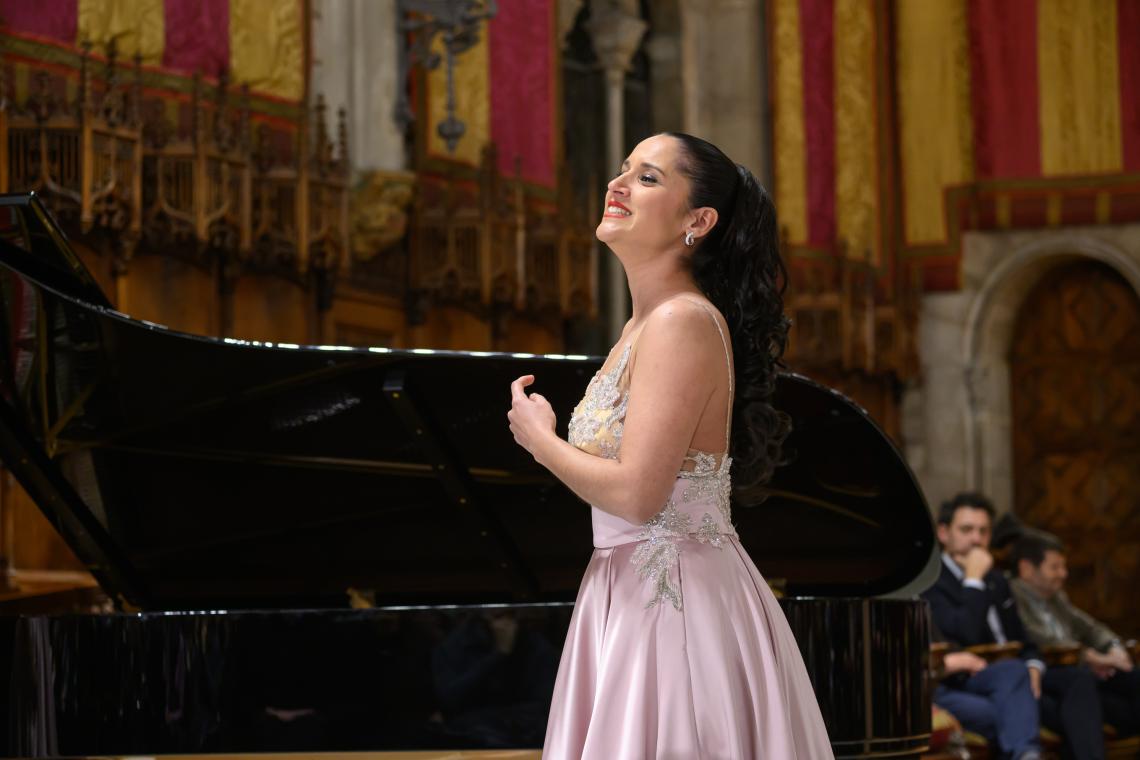
Soprano Sara Blanch (1989, Darmós, Tarragona), with an established career and recognized international prestige at Europe’s leading opera theatres, has returned to the Tenor Viñas Contest ten years after being awarded Fourth Pize at the 53rd edition in 2016, where she also recieved Prize for Best Zarzuela Performer, among several other distinctions.
As part of the contest’s 63rd edition, the soprano gave a recital of opera arias at the opening ceremony held on Saturday, January 10, in the Saló de Cent at Barcelona City Hall. A particularly symbolic return that reinforces her connection tothe contest that marked a turning point in her career.
The singer arrived in Barcelona after an intense production at the Tyrol Festival in Erl, where she performed Lucia di Lammermoor, and was in the midst of preparing her debut at the Paris Opera in Un ballo in maschera by Verdi, singing the role of Oscar at the end of January. Between the ending of one project and the beginning of another, she still found time to take part in the Contest inauguration with a very special recital.
Just minutes before going on stage, our team had the opportunity to speak with her in an interview in which she reflected on her career, her current challenges, and the personal significance of returning to the Tenor Viñas Contest a decade later.
— How do you feel about returning to the Contest after ten years to perform the recital at the Opening of the 63rd edition at the Saló de Cent?
Very excited, with great enthusiasm and joy. I’ve even had to set my emotions aside a little because I’ve asked myself that same question. Exactly ten years have passed, and when I look back, everything the Viñas Competition has meant to me has truly been a lot.
It is a competition that gave me many prizes, in addition to the 4th prize, other awards that allowed me to work in theatres and at a certain professional level. All of that represented very important opportunities at the time, and they must be seized. It had a very positive impact on my career and on my life.
— What has it been like to perform Lucia in Lucia di Lammermoor at the Tyrol Festival?
It has been a very intense experience because it was a production that demanded a great deal from me physically. I was on stage from before the overture until the very last note of the opera, and it was extremely demanding on a physical, vocal, and mental level to remain on stage the entire time.
But it has also given me great satisfaction, as it is a role I have already performed and one that is deeply fulfilling. The challenge has also been significant: shortly after finishing those performances, I began rehearsals at the Paris Opera, and now I am here. It has been a lot, very intense, very important and emotional for me—many emotions in a short period of time.
— How did you prepare the programme for the Opening recital of the 63rd Competition?
The programme opens and closes with the two pieces I sang at the final concert of the Viñas. For me, it was a kind of tribute to the competition: opening and closing with those two pieces, “Una voce poco fa” and “La primorosa.”
In between, I included a bit of everything I have been performing and the path I have followed over these ten years. I also tried, thinking about the prizes I received at the Viñas, to give it a meaningful structure. For example, I received the award for Best Catalan Singer, so I included a Catalan sardana piece (“En el Vallespir,” from Cançó d’amor i de guerra by Martínez i Valls).
Regarding the award for Best Zarzuela Singer, I included “La primorosa.” The Viñas also has many other prizes, such as the Mozart Prize, so I included a Mozart aria as well. I tried to create a parallel between the competition and my situation ten years ago and now.
— What remains of the Sara who competed ten years ago?
It remains—there is always something that remains. The essence remains. When I look back, I do see that much more inexperienced Sara, and I see everything I have learned, the opportunities I have had, and all the repertoire I have sung. Many things. But the essence always remains; it is always there.
— How did you experience the Competition? What do you remember about that time?
I remember that at the time I was performing in a production in Sarrià. I registered for the competition but thought I wouldn’t actually take part. At home, I even said that I hadn’t registered. I thought: “If I do take part, it will be the day they summon me, and I’ll do what I have to do if that day I feel like it.”
I decided as I went along because the previous year I had competed and did not reach the final. So I said: I’ll enter, but since I was already working and doing a production and was happy, everything happened very spontaneously. And I believe that played in my favour, because I removed a burden and a sense of responsibility, and I went simply to enjoy each moment and give my best.
When I reached the final, I called home to tell them; they could hardly believe it. It was very emotional. I also remember how everything worked inside the competition: the precision with which it was organised. I remember some staff members who encouraged me greatly, and all that warmth that the other singers also received. I think there is a supportive aspect to this competition that is very beautiful, very close, and very important.
The Viñas Contest is my contest. I have taken part in other competitions, some smaller ones that I have won, others similar ones that awarded me a prize, and also competitions where I was not selected — and that’s perfectly fine.
— What is the most important skill a singer must have?
The most important thing is to work on oneself. I always try to become better, not only in singing but in every aspect. To become a better person, of course.
Everything that can help the singing improve: constantly refining technique, becoming musically stronger, mentally and emotionally stronger, learning to manage situations better… I believe it’s a whole package, and the work always begins from within, step by step.